Menlo Park voters will decide Measure P in the November 3, 2026 election. The measure concerns the future of the City's publicly owned downtown parking plazas and has generated a significant debate involving affordable housing, downtown businesses, parking, local control and the role voters should play in major decisions involving public land.
The debate is sometimes presented in very simple terms: either Measure P is necessary to protect downtown parking, or Measure P will prevent affordable housing from being built.
The actual issue is more complicated.
Measure P does not categorically prohibit housing or development on the downtown parking lots. Instead, it would require voter approval before the City takes certain actions affecting the City-owned downtown parking plazas when those actions would diminish the availability, access or convenience of public parking.
At the same time, the measure could make the City's current plan to develop affordable housing on Parking Plazas 1, 2 and 3 more difficult, slower or subject to another citywide election.
This article examines what Measure P actually does, why the City is considering housing on the downtown parking lots, the strongest arguments on both sides, and whether other housing sites exist in Menlo Park.
This article is intended as an informational analysis and is not an endorsement of either campaign.
What Is Menlo Park Measure P?
Measure P originated as a citizen initiative concerning eight City-owned downtown parking plazas.
According to the City of Menlo Park's official description, the measure would prohibit the City from selling, trading, leasing, donating, disposing of or otherwise conveying all or a portion of the City-owned downtown parking lots if doing so would affect or diminish the availability or convenience of parking, unless voters approve the action.
The initiative goes beyond a simple prohibition on selling the property.
If an action would diminish parking availability, access or convenience, voter approval would generally be required before the City could:
- Sell or otherwise convey a parking plaza;
- Lease all or part of a parking plaza;
- Designate a parking plaza as surplus or exempt surplus land;
- Change its use;
- Construct or modify improvements in a way covered by the measure.
There are exceptions for maintenance, repair and improvements intended to preserve or improve parking, as well as certain temporary activities.
In practical terms, Measure P does not necessarily say “these parking lots can never be redeveloped.”
It says that certain redevelopment decisions affecting parking would require approval from Menlo Park voters.
City of Menlo Park Official Measure P Page
How Did Measure P Get on the Ballot?
The initiative began in May 2025.
According to City records, proponents ultimately submitted 3,928 petition signatures. San Mateo County election officials reviewed 2,760 of those signatures and verified 2,200 as valid—more than the 2,103 required to qualify the initiative.
The City Council subsequently voted to place the measure on the November 3, 2026 ballot.
The ballot measure therefore represents a qualified citizen initiative rather than an ordinance originally proposed by the City Council.
The campaign materials submitted for the voter guide show substantial disagreement over the consequences of the measure. Proponents argue that voters should have final approval before valuable public parking land is committed to development, while opponents argue that the measure could obstruct affordable housing and reduce the City's flexibility.
Why Is Menlo Park Considering Housing on Downtown Parking Lots?
The controversy cannot be understood without looking at Menlo Park's 2023–2031 Housing Element.
California requires cities to plan for their share of regional housing needs. Menlo Park's Regional Housing Needs Allocation, or RHNA, for the current cycle is approximately 2,946 homes across different income levels.
Menlo Park's Housing Element identified approximately 70 potential housing opportunity sites throughout the city.
Those sites include properties in and around:
- Downtown and El Camino Real;
- Sand Hill Road;
- Willow Road;
- Middlefield Road;
- Bohannon Drive;
- Commercial areas;
- Certain religious properties;
- Other locations throughout Menlo Park.
The City's downtown parking plazas are therefore not the only sites identified for possible housing.
However, they have an unusual characteristic: the City already owns the land.
Why City Ownership Matters for Affordable Housing
Land in Menlo Park is extremely expensive.
For an affordable-housing developer, acquiring private land can represent a substantial portion of the project's cost.
With City-owned property, Menlo Park can potentially contribute the land through a long-term ground lease or similar arrangement, substantially reducing the land-acquisition burden.
That makes the downtown parking lots particularly attractive for deeply affordable housing.
The City's Housing Element includes Program H4.G, which prioritizes affordable housing on City-owned downtown parking lots and establishes a goal of creating at least 345 homes affordable to very-low-income households.
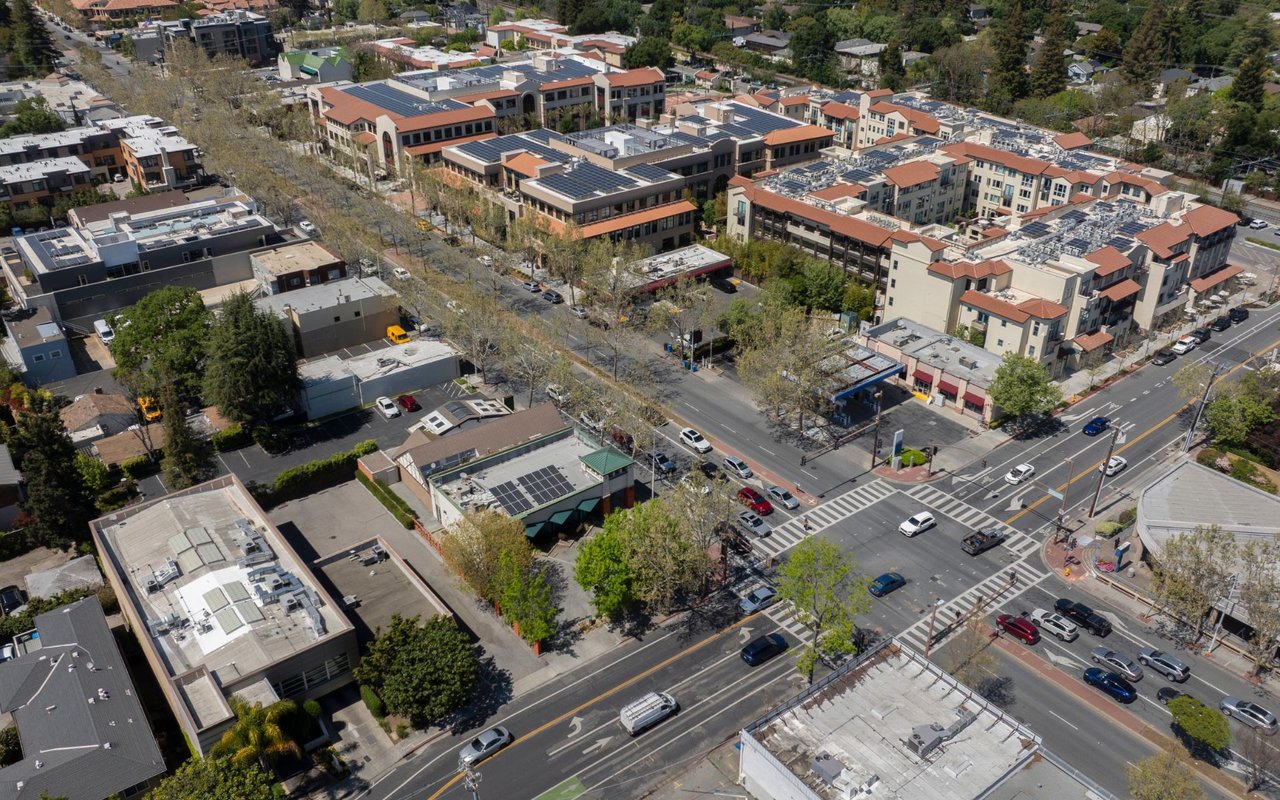
The City is currently evaluating Parking Plazas 1, 2 and 3, located north of Santa Cruz Avenue.
Menlo Park Downtown Parking Lot Development Project
Why Parking Plazas 1, 2 and 3?
The City evaluated all eight downtown parking plazas before focusing on Plazas 1, 2 and 3.
According to the City's project information, considerations included:
- Lot size and configuration;
- Development potential;
- Proximity to transit;
- Access to goods and services;
- Street access;
- Ability to incorporate replacement parking.
The City's current objective is not simply to remove the parking spaces.
Development proposals have been asked to incorporate replacement public parking along with housing and potentially other uses.
The City has said that if all three parking plazas were developed, at least 506 replacement public parking spaces should be provided, with replacement of all 556 existing spaces preferred if feasible.
That distinction is important.
The controversy is therefore not simply:
Housing versus 556 parking spaces disappearing.
The real questions include how much parking would be replaced, where it would be located, how convenient it would be, what it would cost, how construction would affect downtown, and who would ultimately pay for the replacement parking.
What Housing Is Currently Being Proposed?
Three development teams submitted proposals in response to the City's process:
- Alliant Communities;
- Presidio Bay Ventures;
- Related California / Alta Housing.
The concepts differ in financing, housing mix, parking configuration and other details.
For example, one proposal states that it could provide all 345 housing units and all 556 replacement public parking spaces. Other proposals contemplate different financing and parking arrangements.
As of September 2026, the City has not simply approved one final project and begun construction. The proposals have been undergoing public review and financial analysis.
That is another important distinction when evaluating campaign claims.
The Strongest Argument for Measure P: Public Land and Voter Control
The central argument for Measure P is straightforward:
The downtown parking lots are valuable public assets, and voters should have a direct say before their use is substantially changed.
Supporters contend that these properties serve downtown businesses, employees and visitors and that replacing surface parking with structured parking and housing could create significant costs or disruption.
Their official argument also raises concerns about the financial consequences of replacement parking and argues that Menlo Park has other opportunities to provide housing without sacrificing the downtown plazas.
From this perspective, Measure P does not prohibit development.
It imposes an additional democratic check:
If a future proposal is sufficiently beneficial, supporters argue, the City should be able to persuade voters to approve it.
That is a legitimate governance argument even for someone who generally supports additional housing.
The Strongest Argument Against Measure P: Flexibility and Affordable Housing
Opponents make a different argument.
They contend that requiring a citywide election before the City can proceed with certain uses of its own downtown property would make affordable-housing projects more difficult, uncertain and time-consuming.
Affordable-housing developments often depend upon complicated combinations of:
- State funding;
- Federal funding;
- Tax credits;
- Local subsidies;
- Private financing;
- Development deadlines.
Adding the uncertainty of a future election could potentially affect financing or project timing.
The official opposition also argues that downtown Menlo Park is an important location for affordable housing because it provides access to transit, businesses, services and other opportunities.
That concern should not simply be dismissed.
Why Not Build the Affordable Housing Somewhere Else?
This is perhaps the most important factual question in the Measure P debate.
Other potential housing sites clearly exist.
Menlo Park's own Housing Element identifies approximately 70 opportunity sites.
It specifically includes commercial and redevelopment areas along locations such as Bohannon Drive, Willow Road and Middlefield Road, in addition to downtown sites.
The City's environmental review has identified multiple properties around Bohannon Drive and elsewhere as potential housing opportunity sites.
Therefore, it would not be accurate to say that the downtown parking plazas are literally the only land in Menlo Park where housing can be developed.
[EXTERNAL LINK → Menlo Park Housing Element]
What About Land Near Meta and the Bayfront?
Menlo Park also has substantial housing development and redevelopment potential in the eastern portion of the city, including areas near Belle Haven and the Bayfront.
At first glance, this raises an obvious question:
Why use scarce downtown parking lots when considerably larger parcels exist elsewhere?
There are several answers.
First, many of those other properties are privately owned.
The City cannot simply decide to construct affordable housing on privately owned land. It may need to:
- Purchase the property;
- Persuade the owner to develop it;
- Rezone it;
- Offer development incentives;
- Apply affordability requirements;
- Negotiate affordable units as part of a larger project.
The economics are therefore very different from development on land the City already owns.
Second, Menlo Park's housing obligations involve more than producing a certain number of units.
The Fair-Housing Issue: Why Location Matters
California housing policy requires cities to affirmatively further fair housing.
One objective is to avoid concentrating affordable housing only in historically lower-income areas.
Belle Haven and the Bayfront area already contain and are expected to absorb substantial new housing development.
From the City's perspective, affordable housing in central or western Menlo Park provides access to a high-resource area and distributes affordable-housing opportunities more broadly throughout the community.
This is arguably the strongest substantive response to the proposal that all or most additional affordable housing could simply be moved closer to Meta.
The concern can fairly be stated this way:
If western Menlo Park preserves its valuable public land and surface parking while eastern Menlo Park absorbs a disproportionate share of new affordable housing, is that an equitable housing policy?
That is a legitimate question.
But it does not necessarily establish that these particular downtown parking plazas are the only possible solution.
Are the Downtown Lots “Essential” to Menlo Park's Housing Requirement?
This is where the issue has become more nuanced.
The Housing Element unquestionably contains a program calling for affordable housing on the downtown parking lots.
However, the City's current project page also reports that Menlo Park's projected housing capacity now exceeds its RHNA allocation in every income category.
That does not make the downtown affordable-housing program irrelevant.
RHNA planning, actual housing production, affordability levels, fair-housing distribution and individual Housing Element commitments are related but distinct issues.
Still, the existence of excess projected capacity makes it difficult to characterize the question as simply:
“Without these parking lots, Menlo Park cannot accommodate its housing allocation.”
The more precise statement is:
Measure P could interfere with or delay an important affordable-housing program contained in Menlo Park's Housing Element, but Menlo Park also has numerous other housing opportunity sites and currently reports projected capacity exceeding its RHNA allocation.
That distinction matters.
Could Alternative Sites Provide Affordable Housing in Western or Central Menlo Park?
This may be a more useful question than simply asking whether housing could be shifted to the Bayfront.
There are major private redevelopment opportunities around Menlo Park, including sites closer to central and western portions of the city.
The Measure P proponents have pointed to substantial housing proposals at other major sites and argue that the City could negotiate for additional affordable units there rather than rely on the parking plazas.
Whether those alternatives can deliver the same number and depth of affordable units, on the same timetable and at comparable public cost, is a different question.
Private redevelopment generally gives the City less direct control than development of City-owned land.
That is an important advantage of the downtown sites.
What About the Cost of Replacement Parking?
Measure P proponents have raised the possibility that replacement structured parking could impose tens of millions of dollars in costs.
Those figures should be treated carefully.
They are campaign claims and project-specific estimates rather than a settled cost to taxpayers.
There is evidence that structured replacement parking can be expensive.
An earlier UC Berkeley conceptual study estimated approximately $39 million for two parking structures, with roughly $9 million potentially contributed from market-rate development and approximately $30 million requiring another funding source.
The current developer proposals have different financing concepts.
For example, one 2026 City summary shows proposed developer contributions ranging from approximately $5 million to $15 million toward replacement parking in certain proposals, while another proposal indicated no City contribution for replacement public parking.
The City has ordered an independent financial review of the current proposals.
Therefore, the fairest conclusion at this stage is:
Replacement parking may be expensive, but the final cost to Menlo Park taxpayers cannot yet responsibly be stated as a fixed number because it depends on the project selected, financing structure, developer contribution and final parking design.
Would Measure P Preserve Parking Forever?
No.
That description would also overstate the measure.
Measure P generally requires voter approval for covered actions that diminish parking availability, access or convenience.
If voters later approve a redevelopment proposal, the property could potentially be redeveloped.
Maintenance and improvements that preserve or improve parking can also proceed without a citywide election under the measure's exceptions.
The practical consequence is therefore less:
“Nothing can ever change.”
and more:
“Certain significant changes cannot proceed without voter approval.”
Would Measure P “Block Affordable Housing”?
That phrase also needs qualification.
Measure P would likely make the specific downtown-parking-plaza affordable-housing strategy more difficult because covered redevelopment would have to satisfy the initiative's requirements, potentially including another election.
But Measure P does not prohibit Menlo Park from building or approving affordable housing elsewhere.
Menlo Park's Housing Element contains dozens of other opportunity sites. The City's zoning changes also allow additional residential and mixed-use development across various commercial and residential areas.
The statement:
“Measure P blocks affordable housing in Menlo Park”
is therefore too broad.
A more accurate statement is:
“Measure P could delay, complicate or prevent the City's currently planned affordable-housing development on the downtown parking plazas unless voters approve the required change.”
The distinction between those two statements is significant.
The Downtown Business Question
Downtown businesses also have a legitimate interest in the outcome.
Surface parking currently provides convenient access to Santa Cruz Avenue businesses.
Housing could bring new residents and potentially additional customers downtown, but construction and changes in parking configuration could also affect existing businesses.
The City's own objective analysis recognizes both possibilities: new housing could increase local spending, while preserving existing surface parking would provide stability but could limit the City's ability to introduce new uses and investments.
The effect therefore cannot fairly be described as automatically positive or automatically negative.
Much depends on:
- Construction phasing;
- Replacement parking;
- Parking location;
- Accessibility;
- Project design;
- Retail components;
- Number of residents;
- Duration of construction.
What Does Measure P Really Ask Voters to Decide?
After separating the factual issues from the campaign messaging, Measure P is fundamentally about who should have final decision-making authority over major changes to the downtown parking plazas.
Without Measure P, those decisions generally remain within the City's normal planning, environmental-review and City Council processes, subject to applicable state law.
With Measure P, voters would gain an additional direct approval role for covered actions affecting the parking plazas.
That creates a real tradeoff.
The argument for voter approval
The land is publicly owned, downtown parking affects the broader community and businesses, and major irreversible changes should not occur without direct voter consent.
The argument against voter approval
Land-use decisions are complicated, projects evolve over time, affordable-housing financing is difficult, and requiring another election could reduce the City's ability to respond efficiently to housing needs and changing circumstances.
Reasonable people can reach different conclusions about which model is preferable.
A Fair Reading of Measure P
Based on the available public record, several conclusions appear reasonably clear.
First, Menlo Park has other potential housing sites.
The City's own Housing Element identifies dozens of them, including areas outside downtown.
Second, the downtown parking plazas nevertheless have real advantages for affordable housing.
The City owns the land, the sites are centrally located, and affordable housing there advances the City's objective of distributing affordable housing into high-resource areas.
Third, Measure P does not permanently prohibit housing on the parking plazas.
It creates a voter-approval requirement for covered changes that diminish parking availability, access or convenience.
Fourth, that voter requirement could have meaningful consequences.
It could delay or make financing and approval of the City's downtown affordable-housing program more uncertain.
Fifth, it is premature to treat any particular replacement-parking cost as established fact.
The current proposals contain different parking and financing structures, and the City is reviewing their financial feasibility.
Finally, Measure P should not accurately be reduced to either “saving parking” or “stopping affordable housing.”
The real issue combines public-land governance, affordable housing, fair-housing policy, downtown economics and the level of direct voter control residents want over City-owned property.
Conclusion: What Is the Most Accurate Way to Think About Measure P?
The factual record does not support the most absolute version of either campaign's argument.
It is not accurate to say that Measure P eliminates affordable housing in Menlo Park. The City has numerous other housing opportunity sites, significant housing development is occurring elsewhere, and the City currently reports projected housing capacity above its RHNA requirement.
But it would also be inaccurate to say that Measure P has no meaningful consequence for affordable housing. The City deliberately selected its downtown land for an important affordable-housing program, and requiring another public vote could create delay, uncertainty or ultimately prevent a particular proposal from moving forward.
Similarly, the debate should not be reduced to whether Menlo Park needs affordable housing. Both sides can support affordable housing while disagreeing about where it should be built, what public resources should be committed, how replacement parking should be financed, and who should make the final decision.
The strongest case against Measure P is therefore not that there is “nowhere else” to build affordable housing. Other sites exist.
The stronger argument is that City-owned downtown land provides advantages that may be difficult to reproduce elsewhere—especially land cost, location and fair-housing benefits—and requiring a citywide vote reduces the City's flexibility to use those assets.
Conversely, the strongest case for Measure P is not that downtown housing is inherently undesirable.
The stronger argument is that these are valuable public properties serving an established downtown, and voters should have direct approval authority before the City commits them to a long-term use that could materially change parking and downtown circulation.
Ultimately, voters are being asked to decide between two legitimate public-policy values:
flexibility for elected officials to implement housing and land-use policy, and
direct voter control over major changes to publicly owned downtown parking property.
Understanding that tradeoff provides a more accurate picture of Measure P than either campaign slogan alone.
About Milad Real Estate
Milad Real Estate provides real estate representation and local market information for Menlo Park and surrounding Peninsula communities.