Silicon Valley Homebuyer Guide | Updated November 2026 | 2027 Outlook
Buying a home in Silicon Valley requires more than finding an attractive property and submitting an offer. In competitive communities such as Palo Alto, Menlo Park, Atherton, Los Altos, and Woodside, successful homebuyers need a clear strategy that addresses financing, property valuation, due diligence, negotiation, and market conditions.
Much like a game of chess, purchasing real estate involves anticipating challenges, evaluating alternatives, and understanding how each decision may affect the outcome.
The strongest homebuying strategy is not necessarily offering the highest price. It is making a well-informed purchase that balances competitiveness, financial responsibility, and appropriate protection against property-related risks.
As the market moves from 2026 into 2027, buyers should prepare for significant differences among Silicon Valley neighborhoods, property types, and price ranges.
This guide explains how to approach the homebuying process strategically, from mortgage preapproval to successfully completing a purchase.
What Makes the Silicon Valley Housing Market Competitive in 2026?
Silicon Valley's housing market continues to be influenced by employment opportunities, limited housing inventory, substantial household wealth, and demand for established Peninsula communities.
However, market conditions are not uniform across the region.
According to local housing market reporting published in September 2026, the number of new single-family home listings in Palo Alto declined approximately 9% during the first eight months of 2026 compared with the corresponding period in 2025.
During the same period, buyer competition remained significant for certain desirable properties.
Some homes attracted multiple offers and sold substantially above asking price, while other properties required longer marketing periods or pricing adjustments.
These differences demonstrate why buyers should not rely exclusively on general market headlines.
A carefully priced, move-in-ready home in a highly desirable neighborhood may require a different purchasing strategy than a property needing extensive renovations or one that has remained on the market for several months.
For buyers, understanding these distinctions can create opportunities while reducing the risk of overpaying.
1. Obtain Mortgage Preapproval Before Beginning Your Home Search
One of the most important initial steps in purchasing a home is understanding your financing options.
Before seriously pursuing properties, buyers should speak with a mortgage lender about their borrowing capacity, down payment requirements, interest rates, and anticipated monthly housing expenses.
A mortgage preapproval letter generally indicates that a lender is tentatively willing to lend a specified amount based on the information reviewed.
According to the Consumer Financial Protection Bureau, preapproval can help demonstrate to a seller that a prospective buyer is likely to obtain financing.
However, a preapproval letter is not a final loan commitment or guarantee.
Mortgage approval remains subject to additional requirements, including underwriting, property appraisal, title review, and verification of financial information.
Why Preapproval Matters in Silicon Valley
In a competitive transaction, sellers may evaluate a buyer's financial qualifications alongside the offered purchase price.
A buyer with documented financing, sufficient available funds, and a realistic purchase budget may be better prepared to act when a suitable property becomes available.
Preapproval can also help buyers avoid pursuing homes that exceed their comfortable financial limits.
Importantly, the maximum amount a lender is willing to finance is not necessarily the amount a buyer should spend.
Buyers should independently evaluate their preferred monthly payment, available reserves, other financial obligations, and long-term goals.
2. Understand the Difference Between Prequalification and Preapproval
Mortgage lenders sometimes use the terms prequalification and preapproval differently.
Some lenders issue preliminary estimates based on information supplied by the borrower, while others verify income, assets, credit history, and debts before issuing a more detailed preapproval.
Rather than relying only on the label, buyers should ask what information has actually been verified.
Useful questions include:
- Has the lender reviewed my income and employment documentation?
- Have my available funds and down payment been verified?
- Has my credit history been evaluated?
- Are there unresolved underwriting conditions?
- How long will the preapproval remain valid?
- What documentation may be required before final loan approval?
These questions can help identify potential financing problems before a buyer enters into a purchase agreement.
3. Establish Your Budget Before Looking at Homes
A strategic home search begins with a realistic understanding of the total cost of ownership.
In addition to mortgage principal and interest, buyers should consider:
- Property taxes and applicable assessments
- Homeowners insurance
- Mortgage insurance, when required
- Homeowners association dues, if applicable
- Property maintenance and repairs
- Utilities and landscaping expenses
- Potential renovation costs
- Closing costs and post-closing cash reserves
These considerations are particularly important when purchasing older homes or substantial residential properties.
For example, a home with extensive landscaping, mature trees, a swimming pool, or aging mechanical systems may involve significant ongoing expenses beyond the mortgage payment.
Buyers should establish a comfortable purchase range rather than automatically pursuing the maximum price permitted by their lender.
4. Choose Your Neighborhood Strategically
Silicon Valley contains a wide variety of residential communities, each offering different property characteristics, price points, amenities, and development considerations.
Before making an offer, buyers should determine which locations align with their priorities.
Palo Alto: Established Neighborhoods and Stanford Proximity
Palo Alto offers established residential neighborhoods, proximity to Stanford University, downtown amenities, and convenient access to major Silicon Valley employment centers.
Buyers should evaluate the differences among neighborhoods such as Crescent Park, Old Palo Alto, Professorville, College Terrace, and Midtown.
Architectural characteristics, lot sizes, renovation potential, and individual property conditions vary substantially.
Menlo Park: A Range of Residential Opportunities
Menlo Park offers traditional single-family neighborhoods, luxury residences, and a variety of condominium and townhouse options.
Neighborhoods such as Allied Arts, Central Menlo, West Menlo Park, and Sharon Heights offer distinct residential settings.
Buyers should evaluate local comparable sales, property conditions, commuting needs, and neighborhood characteristics rather than assuming that prices and competition are uniform throughout the city.
Atherton: Luxury Estates and Property-Specific Valuation
Atherton is known for substantial residential properties, privacy, and distinctive luxury estates.
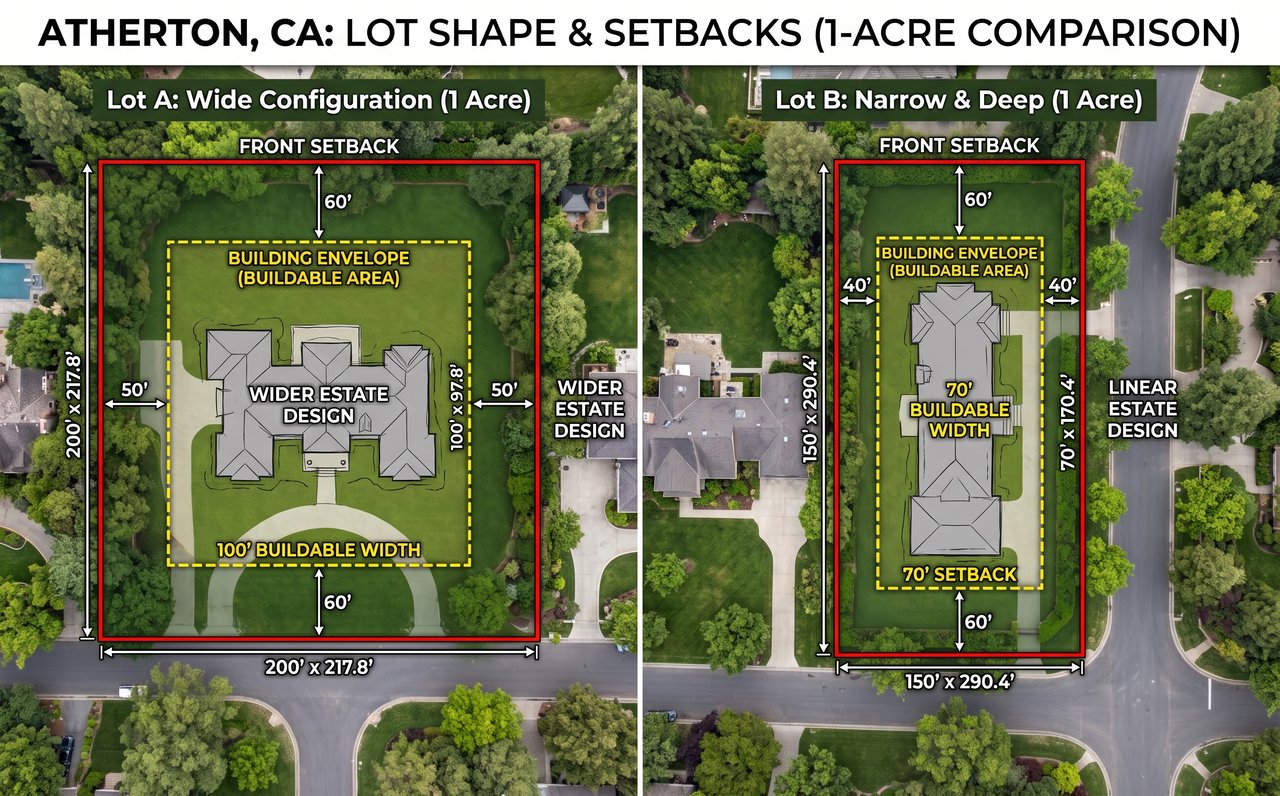
In this market, land configuration, architectural quality, usable acreage, property improvements, and redevelopment potential can significantly influence value.
Because individual properties may differ considerably, evaluating comparable sales requires particular care.
Woodside: Land, Privacy, and Development Considerations
Woodside attracts buyers interested in natural surroundings, larger parcels, and distinctive residential properties.
For some Woodside homes, hillside conditions, drainage, easements, access, and development restrictions can be especially important.
Buyers should investigate these issues before making assumptions about expansion or construction opportunities.
5. Study Comparable Sales Instead of Relying on Asking Prices
One of the most important strategic decisions is determining how much a property is actually worth.
An asking price is a seller's marketing decision. It is not necessarily an accurate representation of market value.
In certain competitive Silicon Valley neighborhoods, sellers may intentionally establish an asking price below their anticipated selling price to attract buyer interest.
Other properties may be priced above what recent comparable sales support.
Buyers should evaluate recently sold properties with similar characteristics, including:
- Location and neighborhood
- Lot size and usable land
- Interior living area
- Age, architecture, and construction quality
- Remodeling and overall property condition
- Floor plan and functional layout
- Development or expansion potential
- Market conditions at the time of sale
For luxury properties, a careful comparative market analysis may require adjustments for characteristics that are not easily reflected in a simple price-per-square-foot calculation.
A buyer should determine a reasonable value range before deciding how aggressively to negotiate.
6. Understand California's Buyer Representation Requirements
California's real estate representation requirements changed significantly beginning in 2025.
Under California Assembly Bill 2992, buyer-broker representation agreements must be executed as soon as practicable, but no later than the buyer's execution of an offer to purchase real property.
California regulations also establish a rebuttable presumption that it is practicable for a buyer's agent to obtain the signed agreement before providing an in-person or virtual property showing.
Additionally, the nationwide real estate commission settlement established requirements for many MLS-participating buyer agents to obtain written representation agreements before touring properties with buyers.
These agreements generally address the broker's services, compensation, and the duration of the representation relationship.
Buyer-agent compensation is negotiable and should be discussed and agreed upon before the representation agreement is signed.
Prospective buyers should carefully review the agreement, including its scope, exclusivity, compensation provisions, duration, and termination terms.
For additional information, see the California Department of Real Estate's Buyer Representation Consumer Alert.
7. Review Property Disclosures Before Making an Offer
In many Silicon Valley transactions, sellers make property disclosures and inspection reports available to prospective buyers before the offer deadline.
These documents can provide valuable information about the property's physical condition, history, improvements, and potential concerns.
Depending on the transaction, documents may include:
- Transfer Disclosure Statement
- Seller Property Questionnaire
- Natural Hazard Disclosure Report
- General property inspection report
- Wood-destroying pest inspection report
- Roof inspection report
- Sewer inspection report
- Preliminary title report
- Permit records and improvement documentation
- HOA documents, if applicable
Buyers should review these documents carefully and obtain appropriate professional advice when questions arise.
Seller-provided inspections can be useful, but they may not address every condition or substitute for independent investigations appropriate to the property.
8. Investigate the Property Beyond Its Appearance
A home's cosmetic appearance should not be the sole basis for a purchasing decision.
In established Peninsula communities, buyers may encounter residences with older electrical systems, aging plumbing, deferred maintenance, foundation concerns, or unpermitted improvements.
Properties with substantial land may also present issues involving easements, setbacks, drainage, protected trees, or development restrictions.
Buyers considering remodeling, expansion, an accessory dwelling unit, or new construction should investigate whether their plans are feasible under applicable regulations.
Important Due Diligence Questions
- Are the existing improvements properly permitted?
- Does the property have known structural or drainage concerns?
- Are there easements affecting the intended use of the land?
- Do the property boundaries match the buyer's expectations?
- Are there zoning, setback, or height restrictions affecting future improvements?
- Are there heritage-tree or other environmental restrictions?
- Is suitable insurance available at an acceptable cost?
- Are there significant near-term maintenance or replacement expenses?
Not every property requires the same investigations. The appropriate level of due diligence depends on the home's age, location, condition, intended use, and the buyer's objectives.
9. Develop a Competitive Offer Without Taking Unnecessary Risks
When a desirable home attracts multiple interested buyers, the terms of an offer can be nearly as important as the proposed purchase price.
Sellers may consider factors such as:
- Offered purchase price
- Down payment and proof of funds
- Mortgage financing strength
- Appraisal and financing contingencies
- Property investigation contingencies
- Closing timeline
- Possession and rent-back terms
- Other contractual conditions
A strong offer should reflect the buyer's financial capacity, the property's value, and the seller's priorities.
However, buyers should not waive important protections solely to make an offer appear more competitive.
Removing contingencies can create significant financial and legal risks if financing is unavailable, the property does not appraise as expected, or undiscovered defects become apparent.
Each contingency decision should be evaluated based on the particular transaction and the buyer's ability to accept the associated risks.
10. Understand the Risks of Waiving Contingencies
In highly competitive housing markets, some buyers consider removing financing, appraisal, or property investigation contingencies.
Although such terms may strengthen an offer from a seller's perspective, they can substantially increase the buyer's exposure.
Financing Contingency
A financing contingency can provide contractual protection if the buyer cannot obtain the specified financing, subject to the terms and deadlines of the purchase agreement.
Without that protection, a financing failure may place the buyer at risk of default and potential contractual liability.
Appraisal Contingency
An appraisal contingency may allow the buyer to address a situation in which the property's appraised value is lower than expected.
Without an applicable appraisal contingency, the buyer may need additional cash to complete the transaction if the lender will not finance the anticipated amount.
Property Investigation Contingency
A property investigation contingency can provide an opportunity to evaluate the property's condition and other relevant matters before proceeding.
Waiving this protection may limit the buyer's contractual options if serious concerns are discovered after acceptance.
Buyers should understand the applicable California purchase agreement and consult qualified professionals before deciding to remove contingencies.
11. Use Negotiation Strategy, Not Emotion
Purchasing a home can be an emotional experience, particularly when a buyer finds a property that closely matches long-term goals.
However, allowing emotions to control the negotiation can lead to financial decisions that are difficult to justify.
Before submitting an offer, buyers should establish:
- A reasonable estimated market value
- A preferred offer price
- A maximum comfortable purchase price
- Acceptable contractual terms
- Nonnegotiable property requirements
- Conditions under which they would walk away
The willingness to decline an unsuitable transaction is an important part of a disciplined purchasing strategy.
In some circumstances, buyers may gain negotiating leverage when a property has remained on the market for an extended period, undergone price reductions, or presents concerns that reduce buyer interest.
However, market time alone does not establish that a property is overpriced or that the seller will accept a substantial discount.
12. Prepare for Appraisal and Financing Challenges
In competitive transactions, a buyer's agreed purchase price may exceed the amount supported by a lender's appraisal.
When the appraised value is below the purchase price, the lender may reduce the amount it is willing to finance.
The buyer may then need to contribute additional funds, renegotiate the terms, consider available contractual options, or pursue alternative financing.
For buyers purchasing luxury properties in Atherton, Palo Alto, or Menlo Park, specialized jumbo mortgage underwriting and appraisal considerations may also apply.
Discuss these possibilities with the mortgage lender before submitting an offer, especially when considering a purchase above recent comparable sales.
13. Plan for the Closing Process Before Your Offer Is Accepted
A strategic buyer should understand the expected transaction timeline before entering into a purchase agreement.
Important closing activities may include:
- Opening escrow and depositing the agreed earnest money
- Completing contractual investigations
- Obtaining the lender's appraisal and final underwriting approval
- Reviewing title and property-related documents
- Obtaining homeowners insurance
- Reviewing the Closing Disclosure and final settlement figures
- Completing the final property walkthrough
- Signing closing documents and arranging funds
- Recording the deed and completing the transaction
Buyers should monitor contractual deadlines and coordinate closely with their real estate representative, lender, escrow holder, and other professionals.
Missed deadlines can have significant consequences, depending on the contract and surrounding circumstances.
14. Think Beyond the Purchase: Long-Term Ownership Strategy
Successful homebuying extends beyond the date escrow closes.
Buyers should consider how the property fits their future plans, including family needs, commuting patterns, maintenance expectations, and potential renovations.
For homes with development potential, buyers may also want to evaluate accessory dwelling units, property improvements, or future construction opportunities.
However, potential improvements should never be assumed to be legally permissible without verifying applicable zoning, building, and other requirements.
Long-term ownership expenses, market fluctuations, and future resale considerations should also be part of the purchasing decision.
Homebuying Strategy Checklist for 2026–2027
Before submitting an offer on a Silicon Valley property, consider the following checklist:
- Obtain mortgage preapproval and verify available funds.
- Establish a comfortable purchase budget.
- Understand buyer representation and compensation terms.
- Research the neighborhood and recent comparable sales.
- Review available disclosures and inspection reports.
- Investigate title, easements, permits, and property restrictions.
- Evaluate renovation and development feasibility when relevant.
- Determine an appropriate offer price and maximum purchase price.
- Review contingency risks and contractual deadlines.
- Coordinate the anticipated closing timeline with the lender and escrow holder.
- Preserve sufficient financial reserves after closing.
- Be prepared to decline a transaction that does not meet your objectives.
Frequently Asked Questions About Buying a Home Strategically
What is the first step in buying a home in Silicon Valley?
A useful first step is establishing a realistic financial budget and discussing mortgage preapproval with a lender. Buyers should understand both their borrowing capacity and the total cost of ownership before beginning a serious property search.
Do I need mortgage preapproval before making an offer?
Preapproval is not universally required by law to submit a purchase offer, but sellers frequently expect evidence of financing or sufficient available funds. A preapproval letter can help demonstrate financial readiness, although it does not guarantee final loan approval.
Should I offer above asking price in Palo Alto or Menlo Park?
Not automatically. The appropriate offer depends on comparable sales, property characteristics, market conditions, and buyer competition. Asking prices may be set above or below estimated market value, so a property-specific analysis is essential.
Is it safe to waive inspection contingencies?
Waiving inspection contingencies can create substantial risks. Buyers should understand the property's condition, available disclosures, and the contractual consequences before removing any protection.
Do California homebuyers need a buyer representation agreement?
California law requires buyer-broker representation agreements for applicable buyer representation services. For most MLS-participating buyer agents, written agreements are also required before touring homes with buyers. Compensation and other terms should be reviewed and negotiated before signing.
How can I make my offer more attractive without increasing the price?
Depending on the seller's priorities, a buyer may improve an offer through verified financing, reliable proof of funds, a suitable closing schedule, or other acceptable contractual terms. Any changes to contingencies or protections should be carefully evaluated.
Is 2027 a good time to buy a home in Silicon Valley?
Whether 2027 is a suitable time to buy depends on the buyer's financial circumstances, available properties, financing costs, and long-term objectives. Future housing prices and mortgage rates are uncertain, so buyers should focus on transactions that are financially sustainable under current conditions.
Final Thoughts: A Successful Home Purchase Begins With Strategy
Buying a home in Silicon Valley requires preparation, careful analysis, and informed decision-making.
Mortgage preapproval is an important starting point, but it is only one component of an effective purchasing strategy.
Successful buyers also understand property values, conduct appropriate due diligence, evaluate contractual risks, and negotiate terms that support their financial and personal objectives.
In competitive markets such as Palo Alto, Menlo Park, and Atherton, the ability to act decisively matters. However, acting quickly should never replace careful judgment.
The objective is not simply to win the bidding process. It is to purchase the right property at a justifiable price under terms that appropriately protect your interests.
Buy Your Next Silicon Valley Home With Milad Real Estate
At Milad Real Estate, we assist homebuyers and sellers throughout Palo Alto, Menlo Park, Atherton, Woodside, Los Altos, Redwood City, and surrounding San Francisco Peninsula communities.
Founded by Aria Vatankhah, a California real estate broker and attorney, Milad Real Estate combines real estate brokerage experience with legal knowledge to help clients navigate property transactions, negotiations, and complex purchasing considerations.
Whether you are buying your first Silicon Valley home, moving into a larger residence, or evaluating a luxury property, we welcome the opportunity to help you develop a thoughtful purchasing strategy.
Explore Silicon Valley communities:
- Palo Alto Real Estate
- Menlo Park Real Estate
- Atherton Luxury Real Estate
- Woodside Luxury Properties
- Los Altos Real Estate
Contact Aria Vatankhah
Real Estate Broker & Attorney | Milad Real Estate
Phone: (650) 799-8168
Email: [email protected]
Sources: Consumer Financial Protection Bureau – Mortgage Preapproval; California Department of Real Estate – Buyer Representation Requirements; Mountain View Voice – Palo Alto Housing Market, September 2026; The Almanac – Midpeninsula Housing Market, September 2026.
Disclaimer: This article is for general informational purposes and does not constitute individualized legal, mortgage, financial, or investment advice. Real estate laws, financing requirements, market conditions, and transaction practices may change. Buyers should review their specific circumstances and obtain appropriate professional guidance before entering into a real estate transaction.