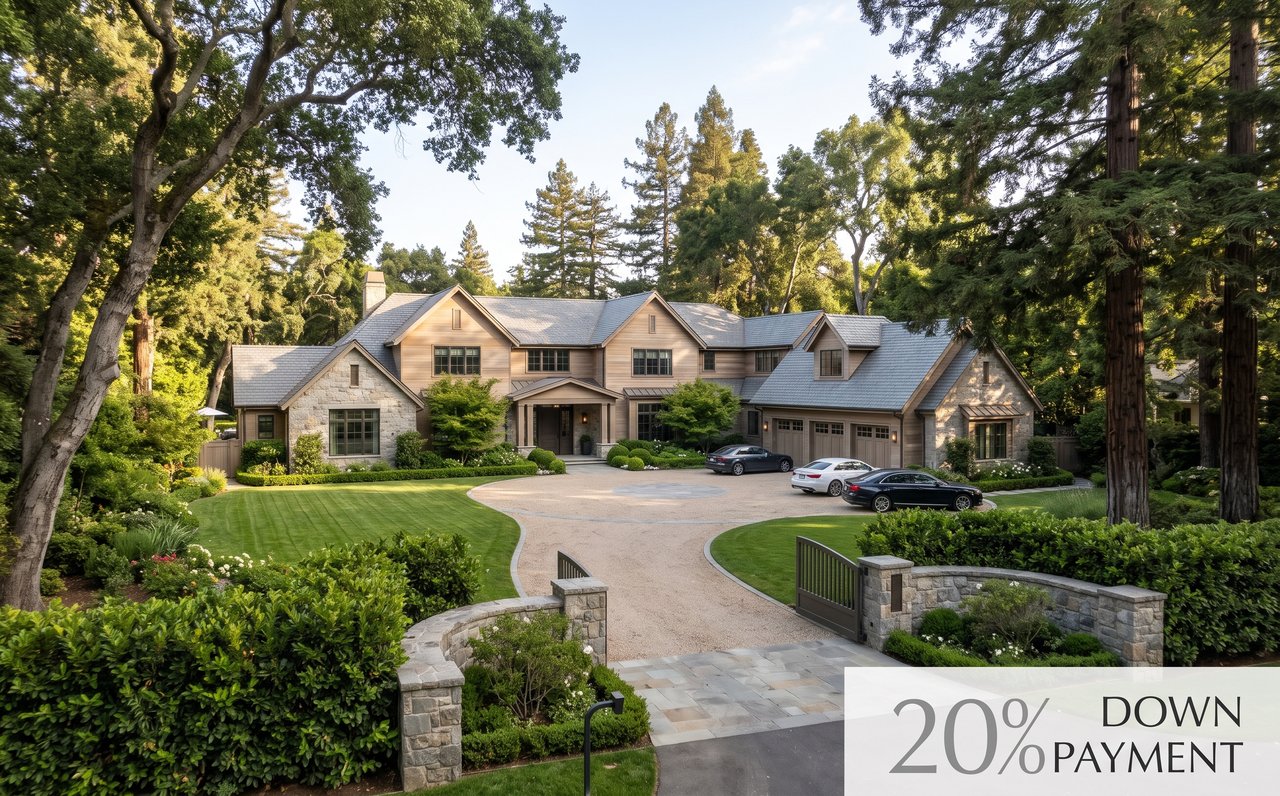
When purchasing a home, one of the most important financial decisions is determining how much money to put down. For decades, a 20% down payment has been considered a traditional benchmark for homebuyers. But is putting 20% down still the best strategy in today's real estate market?
For buyers considering homes in Atherton, Palo Alto, Menlo Park, and surrounding Silicon Valley communities, the answer requires careful consideration.
Putting 20% down can eliminate private mortgage insurance on a conventional loan, reduce monthly mortgage payments, lower overall borrowing costs, and potentially strengthen a buyer's financing position.
However, a larger down payment also means committing more cash to the property, which may not be ideal for every buyer.
This guide explains the benefits and potential drawbacks of a 20% down payment, with practical examples relevant to the Silicon Valley housing market.
What Does Putting 20% Down on a House Mean?
A down payment is the portion of a home's purchase price that the buyer pays upfront rather than financing through a mortgage.
For example, if you purchase a home for $2,000,000, a 20% down payment would equal $400,000.
The remaining $1,600,000 would typically be financed through a mortgage, assuming no additional financing arrangements.
Here is how a 20% down payment works at several purchase prices:
Home Purchase Price | 20% Down Payment | Mortgage Amount |
|---|---|---|
$1,500,000 | $300,000 | $1,200,000 |
$2,000,000 | $400,000 | $1,600,000 |
$3,000,000 | $600,000 | $2,400,000 |
$5,000,000 | $1,000,000 | $4,000,000 |
These examples illustrate the down payment and mortgage principal only. They do not include closing costs, property taxes, insurance, or other expenses.
In Silicon Valley's luxury housing market, the amount of cash required for a down payment can be substantial, making financing strategy especially important.
1. Avoid Private Mortgage Insurance (PMI)
One of the most widely recognized benefits of putting 20% down on a home is avoiding private mortgage insurance, commonly called PMI.
According to the Consumer Financial Protection Bureau (CFPB), borrowers who make a down payment of less than 20% on a conventional mortgage are commonly required to purchase PMI.
PMI protects the mortgage lender if the borrower defaults on the loan. It does not protect the homeowner.
Because PMI adds to the cost of financing a home, avoiding it can reduce monthly housing expenses.
For buyers making a 20% down payment on a conventional loan, PMI is generally not required.
However, mortgage insurance requirements depend on the loan program. Certain government-backed mortgages have different insurance rules, and some financing products use alternative pricing structures.
2. Lower Your Monthly Mortgage Payment
A larger down payment reduces the amount of money borrowed from the mortgage lender.
With a smaller loan balance, your monthly principal and interest payment will generally be lower, assuming the same interest rate and loan term.
Consider a $2,000,000 home purchase:
Down Payment | Cash Down | Mortgage Amount |
|---|---|---|
10% | $200,000 | $1,800,000 |
20% | $400,000 | $1,600,000 |
By increasing the down payment from 10% to 20%, the buyer reduces the mortgage principal by $200,000.
That smaller mortgage balance generally translates into lower monthly principal and interest payments and less interest paid over the life of the loan.
Actual payment differences depend on the mortgage rate, amortization period, financing structure, and lender requirements.
3. Potentially Qualify for Better Mortgage Terms
A larger down payment may improve a buyer's mortgage financing options.
Mortgage lenders evaluate several factors when determining loan eligibility and pricing, including:
- Credit score and credit history
- Income and employment stability
- Debt-to-income ratio
- Loan-to-value ratio
- Cash reserves and available assets
- Property value and appraisal
- Mortgage type and loan amount
The loan-to-value ratio, or LTV, measures the mortgage balance relative to the property's value.
With a 20% down payment, the initial LTV is generally 80%, assuming the property's appraised value supports the purchase price.
A lower LTV can reduce lender risk and may result in more favorable financing terms.
However, a 20% down payment does not guarantee the lowest interest rate. Buyers should compare written mortgage offers from multiple lenders before selecting a financing arrangement.
4. Reduce Total Interest Paid Over the Life of the Loan
Another important advantage of a larger down payment is the potential to reduce total mortgage interest expenses.
Mortgage interest is calculated on the outstanding principal balance. Borrowing less generally means paying less interest over time, assuming comparable loan terms.
This becomes particularly significant for higher-priced Silicon Valley homes, where mortgage balances can exceed $1 million or even several million dollars.
For example, reducing a mortgage from $1.8 million to $1.6 million can create substantial long-term interest savings.
However, borrowers should also consider the opportunity cost of committing additional funds to a home rather than maintaining investments, business capital, or other financial reserves.
5. Strengthen Your Position When Buying a Home
In competitive real estate markets, sellers often evaluate more than the purchase price when comparing offers.
A buyer who provides evidence of sufficient funds, strong financing approval, and an appropriate down payment may be perceived as presenting less financing uncertainty.
This can be relevant in desirable communities such as Atherton, Palo Alto, Menlo Park, and Los Altos, where individual properties may attract multiple interested buyers.
A larger down payment may also provide additional flexibility if the property appraises below the purchase price, depending on the buyer's available funds and lender requirements.
However, the down payment percentage alone does not determine the strength of an offer.
Other important factors include loan approval, proof of funds, contingencies, closing timelines, and the buyer's overall financial qualifications.
6. Build More Home Equity From the Beginning
Home equity represents the difference between a property's market value and the outstanding loans secured by the property.
By making a 20% down payment, a buyer begins with a larger equity position than someone purchasing the same home with a smaller down payment, assuming the home's market value equals the purchase price.
For example, a buyer purchasing a $3 million home with $600,000 down begins with approximately $600,000 in equity before accounting for transaction costs or subsequent market changes.
This equity may provide greater flexibility if the owner needs to sell the home or refinance the mortgage.
However, home equity is not guaranteed to remain constant. Property values can decrease, and a larger down payment does not eliminate the financial risks associated with real estate ownership.
Is a 20% Down Payment Required to Buy a Home?
No. A 20% down payment is not required for every home purchase.
Depending on the loan program and borrower qualifications, some buyers may qualify for mortgages requiring substantially less than 20% down.
Conventional mortgage programs may permit down payments as low as 3% for eligible borrowers, while certain government-backed financing programs have their own down payment requirements.
However, the options available to buyers purchasing higher-priced homes in Silicon Valley may be more limited.
In particular, many luxury home purchases require jumbo mortgages, which are subject to lender-specific underwriting standards.
What Is a Jumbo Mortgage, and Why Does It Matter in Silicon Valley?
A jumbo mortgage is a home loan that exceeds the applicable conforming loan limit established by the Federal Housing Finance Agency (FHFA).
For 2026, the conforming loan limit for a one-unit property in San Mateo County and Santa Clara County is $1,249,125.
Mortgage loans exceeding the applicable limit are generally classified as jumbo loans.
Because luxury properties in Atherton, Palo Alto, Menlo Park, and other Peninsula communities often sell for several million dollars, jumbo financing is an important consideration for local buyers.
For example, purchasing a $3 million home with a 20% down payment would result in a $2.4 million mortgage, substantially exceeding the 2026 conforming loan limit.
Jumbo mortgage lenders may impose additional requirements involving creditworthiness, income verification, debt obligations, asset reserves, and down payment amounts.
Some jumbo financing programs permit down payments below 20%, but eligibility and pricing depend on the lender, loan size, and borrower's financial profile.
Buyers should consult lenders experienced in financing high-value Peninsula properties rather than assuming that conventional conforming loan guidelines apply to every purchase.
For official conforming loan limit information, visit the Federal Housing Finance Agency.
Should You Put More Than 20% Down on a Luxury Home?
For buyers purchasing multimillion-dollar properties, putting more than 20% down may offer additional advantages.
A larger down payment can reduce the mortgage balance further, potentially improve financing options, and lower monthly principal and interest payments.
For example, on a $4 million home:
Down Payment | Cash Down | Mortgage Amount |
|---|---|---|
20% | $800,000 | $3,200,000 |
25% | $1,000,000 | $3,000,000 |
30% | $1,200,000 | $2,800,000 |
However, putting more cash into a property is not automatically the best financial decision.
Some buyers prefer to preserve liquidity for investments, business opportunities, renovations, or unforeseen expenses.
The appropriate down payment depends on the buyer's financial resources, borrowing costs, investment objectives, and risk tolerance.
When Might Putting Less Than 20% Down Make Sense?
Although a 20% down payment offers advantages, there are circumstances in which a smaller down payment may be appropriate.
Preserving Cash Reserves
Homeownership involves expenses beyond the mortgage payment, including property taxes, insurance, repairs, and maintenance.
Using nearly all available cash for a down payment can create financial difficulties if unexpected expenses arise.
The CFPB recommends considering emergency savings and other financial needs before determining the maximum amount available for a down payment.
Purchasing a Home That Requires Renovation
In established Silicon Valley neighborhoods, buyers may purchase older properties requiring remodeling or substantial upgrades.
Preserving additional cash for construction costs, permits, architectural services, and unforeseen repairs may be an important consideration.
Maintaining Investment or Business Liquidity
Some buyers, particularly business owners and investors, may prefer to retain funds for other financial commitments.
In such circumstances, accepting a larger mortgage may be a deliberate financial decision rather than a sign of insufficient purchasing power.
However, the potential investment returns should be evaluated against the additional borrowing costs and risks.
What Other Costs Should You Budget for When Buying a Home?
A down payment is only one component of the total cash needed to purchase real estate.
Buyers should also account for:
- Escrow and title-related charges
- Mortgage lender fees and appraisal expenses
- Inspections and property investigations
- Prepaid interest and insurance
- Property taxes and applicable assessments
- Moving and immediate maintenance costs
- Renovation or improvement expenses
- Emergency savings and post-closing reserves
In luxury real estate transactions, lenders may require borrowers to maintain substantial liquid reserves after closing.
For that reason, buyers should obtain a comprehensive estimate of closing costs and post-closing reserve requirements before determining their down payment.
Frequently Asked Questions About Putting 20% Down on a Home
What is the biggest advantage of putting 20% down on a house?
One of the primary benefits is avoiding private mortgage insurance on a conventional loan. A 20% down payment also reduces the loan amount and generally lowers monthly principal and interest payments.
Does putting 20% down guarantee a lower mortgage interest rate?
No. A larger down payment may improve mortgage pricing, but interest rates depend on several factors, including credit score, loan amount, mortgage type, financial qualifications, and lender requirements.
Can I buy a home in Silicon Valley with less than 20% down?
Yes. Some borrowers may qualify for mortgages requiring less than 20% down. However, financing options for higher-priced properties and jumbo mortgages depend on lender-specific requirements.
Does a 20% down payment eliminate mortgage insurance?
A 20% down payment generally eliminates the need for private mortgage insurance on a conventional mortgage. Other loan programs may impose different insurance requirements.
Is it better to put 20% or 10% down on a house?
A 20% down payment generally reduces borrowing costs and may avoid PMI, while putting 10% down preserves more cash. The best option depends on the buyer's financing terms, available reserves, and financial priorities.
Do I need more than 20% down to buy a home in Atherton?
Not necessarily. The required down payment depends on the purchase price, loan amount, lender, and borrower's financial qualifications. Some multimillion-dollar purchases may require substantial down payments or specialized jumbo financing.
Final Thoughts: Is Putting 20% Down Worth It?
Putting 20% down on a home can provide meaningful financial benefits, including avoiding conventional PMI, reducing mortgage balances, potentially improving financing terms, and creating a larger initial equity position.
For buyers purchasing luxury real estate in Silicon Valley, these advantages can be particularly significant because of the high purchase prices involved.
However, committing a substantial portion of available funds to a down payment should be balanced against the need for liquidity, emergency reserves, property improvements, and other financial objectives.
The best down payment is not always the largest amount you can afford. It is the amount that supports your long-term financial goals while allowing you to purchase the right property on sustainable terms.
Buy Your Next Home With Milad Real Estate
At Milad Real Estate, we assist buyers and sellers throughout Atherton, Palo Alto, Menlo Park, Woodside, Los Altos, and the surrounding Silicon Valley communities.
Founded by Aria Vatankhah, a California real estate broker and attorney, Milad Real Estate provides real estate brokerage services informed by experience in property transactions, negotiation, and legal considerations affecting residential real estate.
Whether you are purchasing your first Peninsula home, moving into a larger residence, or considering a multimillion-dollar luxury property, we welcome the opportunity to help you evaluate available properties and navigate the purchasing process.
Explore Silicon Valley real estate:
Contact Aria Vatankhah
Real Estate Broker & Attorney | Milad Real Estate
Phone: (650) 799-8168
Email: [email protected]
Sources: Consumer Financial Protection Bureau – Private Mortgage Insurance; CFPB – Determine Your Down Payment; Federal Housing Finance Agency – Conforming Loan Limits.
Disclaimer: This article is for general educational purposes and does not constitute individualized mortgage, investment, tax, or legal advice. Mortgage qualification requirements, interest rates, and loan programs vary by lender and are subject to change. Buyers should consult appropriate mortgage and financial professionals regarding their individual circumstances.