Silicon Valley Homebuyer Guide | Updated November 2026 | 2027 Outlook
Buying a home is one of the most significant financial decisions many people make. Whether you are purchasing your first condominium, moving into a larger residence, or considering a luxury property in Silicon Valley, achieving your homebuying goals requires preparation, a realistic budget, and a clear purchasing strategy.
For prospective buyers in Menlo Park, Palo Alto, Atherton, Redwood City, Los Altos, and surrounding San Francisco Peninsula communities, preparation is especially important because property prices, financing requirements, and market competition can vary significantly.
As 2026 comes to a close and buyers begin planning for 2027, now is an appropriate time to evaluate your financial readiness and establish a practical homebuying plan.
Successful homebuying begins well before you attend your first open house. Improving your financial position, understanding your financing options, and identifying your priorities can help you make more informed decisions when the right property becomes available.
Here are twelve important steps to help you prepare for purchasing a home in Silicon Valley.
1. Define Your Homebuying Goals
Before beginning your property search, identify what you want to accomplish by purchasing a home.
Are you planning to buy your first residence, move closer to work, obtain additional living space, or purchase a property that better accommodates your long-term plans?
Understanding your objectives can help you distinguish essential property requirements from desirable but optional features.
Consider the following questions:
- Which communities would you prefer to live in?
- What type of property best suits your needs?
- How many bedrooms and bathrooms do you require?
- How important are lot size, outdoor space, and privacy?
- What commuting and transportation considerations matter?
- Do you prefer a move-in-ready home or a property requiring renovation?
- How long do you expect to own the property?
- What monthly housing expense would be financially comfortable?
These considerations should guide your property search and help prevent decisions based solely on emotion or temporary market conditions.
2. Review Your Credit and Financial Position
Your credit history can influence mortgage eligibility, available interest rates, and other lending terms.
Before applying for a mortgage, review your credit reports and identify any errors or outstanding issues that may require attention.
Federal law generally allows consumers to obtain free credit reports through AnnualCreditReport.com.
Buyers preparing for a mortgage may benefit from:
- Paying bills consistently and on time
- Reducing high-interest consumer debt when practical
- Reviewing credit reports for inaccuracies
- Avoiding unnecessary new debt
- Maintaining adequate financial reserves
- Keeping financial documents organized
Opening new credit accounts or making substantial financed purchases shortly before closing can affect mortgage underwriting.
However, buyers should not assume that every credit-related action will improve their score immediately. The effect depends on the individual credit profile.
A qualified mortgage professional can help explain how lenders evaluate credit and debt obligations.
3. Establish a Realistic Home Purchase Budget
Before searching for homes, determine how much you can comfortably afford.
The maximum mortgage amount a lender may approve is not necessarily the amount that best supports your financial circumstances.
In addition to mortgage principal and interest, consider:
- Property taxes and applicable assessments
- Homeowners insurance
- Mortgage insurance, when required
- Homeowners association dues, if applicable
- Utilities and landscaping expenses
- Maintenance and repairs
- Potential renovation costs
- Emergency reserves
- Other household and financial obligations
For buyers considering older Peninsula residences, it may be particularly important to budget for major systems such as roofing, plumbing, electrical components, and heating and cooling equipment.
For luxury properties with extensive grounds, swimming pools, or multiple building systems, ongoing maintenance expenses may also be substantial.
Your ideal home budget should balance the purchase price with the cost of maintaining the property and meeting your other financial goals.
4. Begin Saving for Your Down Payment
Many homebuyers believe that a 20% down payment is always required to purchase a home.
In reality, down payment requirements depend on the loan program, the lender, the property, and the borrower's qualifications.
Some eligible conventional mortgage programs permit down payments as low as 3%.
FHA loans may permit a down payment as low as 3.5% for qualified borrowers. Certain eligible VA and USDA loans may offer no-down-payment financing.
However, minimum-down-payment options are subject to eligibility requirements, loan limits, property restrictions, and lender underwriting.
In higher-priced Silicon Valley markets, buyers may need financing that differs from standard low-down-payment programs.
Down Payment Examples
The following table illustrates several possible down payment amounts.
Purchase Price | 10% Down | 20% Down |
|---|---|---|
$1,000,000 | $100,000 | $200,000 |
$1,500,000 | $150,000 | $300,000 |
$2,000,000 | $200,000 | $400,000 |
$3,000,000 | $300,000 | $600,000 |
$4,000,000 | $400,000 | $800,000 |
These examples illustrate down payment percentages only. They do not establish that a particular loan program or down payment amount will be available for every property or borrower.
In addition to the down payment, buyers should plan for closing costs and retain appropriate reserves.
5. Investigate Available Down Payment Assistance
Some California buyers may qualify for financial assistance programs intended to support homeownership.
For example, the California Housing Finance Agency (CalHFA) administers programs for eligible borrowers, including certain first-time homebuyers.
Its Dream For All Shared Appreciation Loan program has offered qualifying buyers assistance of up to 20% of the purchase price or appraised value, capped at $150,000.
Eligibility requirements include first-time homebuyer qualifications, first-generation homebuyer provisions, income limits, and other program conditions.
The program also involves shared appreciation repayment obligations.
The 2026 Dream For All application period has concluded, and future funding or application availability should be confirmed directly with CalHFA.
Other assistance programs may have different eligibility requirements and funding arrangements.
Visit the California Housing Finance Agency for current program information.
6. Understand Conforming and Jumbo Mortgages in Silicon Valley
Many buyers in Silicon Valley encounter mortgage financing requirements that differ from those in lower-priced housing markets.
For 2026, the Federal Housing Finance Agency established a one-unit conforming loan limit of $1,249,125 for San Mateo and Santa Clara counties.
A conforming mortgage generally meets applicable Fannie Mae or Freddie Mac loan eligibility requirements, including the relevant loan-size limits.
Loans exceeding the applicable conforming limit typically require jumbo or other nonconforming financing.
Jumbo loans may involve different underwriting requirements related to:
- Credit qualifications
- Down payment amounts
- Debt-to-income ratios
- Income and asset verification
- Cash reserve requirements
- Property appraisal and valuation
These requirements vary by lender and loan product.
Buyers should compare available financing options before deciding on a particular purchase price.
The 2027 conforming loan limits should be checked when officially announced rather than assuming that the 2026 limits will remain unchanged.
For official loan limit information, visit the Federal Housing Finance Agency.
7. Obtain Mortgage Preapproval Before Beginning a Serious Home Search
Mortgage preapproval is one of the most useful steps buyers can take before submitting offers.
During the preapproval process, a lender may review information concerning income, employment, assets, debts, and credit history.
Depending on the lender's process, the buyer may receive a letter indicating a tentative borrowing amount.
Preapproval can help establish a purchase budget and demonstrate financial readiness to sellers.
However, a preapproval letter is not a guarantee of final mortgage approval.
Final approval generally remains subject to underwriting, appraisal, property eligibility, and other lender requirements.
Documents Buyers May Need
- Recent pay statements
- W-2 forms or other income documentation
- Federal income tax returns when required
- Bank and investment account statements
- Identification and employment information
- Documentation of outstanding debts
- Information about down payment funds
Self-employed borrowers, business owners, and buyers with substantial equity compensation may encounter additional documentation requirements.
Obtaining mortgage preapproval early can help identify financing questions before a competitive property becomes available.
8. Select the Right Silicon Valley Neighborhoods
Choosing a property involves more than identifying a desirable house.
Buyers should evaluate the communities that best match their financial resources, housing needs, and long-term objectives.
Menlo Park
Menlo Park offers established single-family neighborhoods, townhouses, condominiums, and luxury residential properties.
Areas such as Central Menlo, Allied Arts, and Sharon Heights differ significantly in property characteristics and price ranges.
Palo Alto
Palo Alto provides proximity to Stanford University, established residential neighborhoods, and access to Silicon Valley employment centers.
Buyers should evaluate individual neighborhoods and property characteristics rather than relying on citywide averages.
Atherton
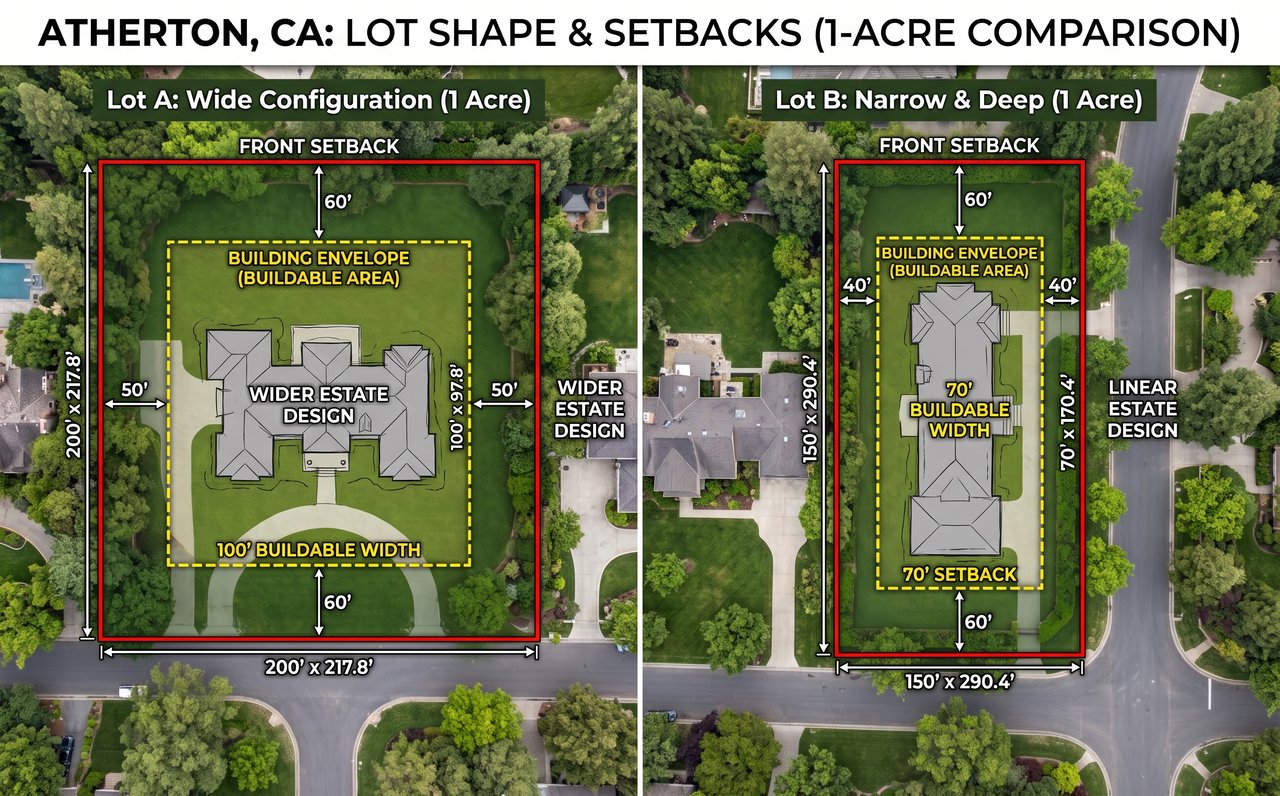
Atherton is known for luxury estate properties, substantial residential parcels, mature landscaping, and privacy.
For buyers evaluating Atherton homes, land characteristics and property-specific valuation can be especially important.
Redwood City
Redwood City offers a variety of neighborhoods, housing types, and access to Peninsula transportation and employment centers.
Properties range from smaller condominiums to substantial single-family residences.
Los Altos
Los Altos offers established residential neighborhoods, local amenities, and access to major Silicon Valley destinations.
Lot size, renovation quality, and neighborhood location can materially affect property values.
The appropriate community depends on your priorities, budget, and preferred property characteristics.
9. Understand Your Buyer Representation Agreement
California's real estate representation requirements changed beginning January 1, 2025.
Under Assembly Bill 2992, buyer-broker representation agreements are required for applicable real estate buyer representation services.
These agreements must be executed as soon as practicable, but no later than the buyer's execution of an offer to purchase real property.
Separate MLS-related industry requirements may also require a written buyer agreement before touring a home with a participating agent.
Before signing a buyer representation agreement, review:
- The services the brokerage will provide
- Broker compensation and payment responsibilities
- Whether the agreement is exclusive
- The duration of the agreement
- Termination provisions
- Any additional contractual conditions
Buyer-broker compensation is negotiable.
California law generally limits the initial term of covered buyer-broker representation agreements to three months, subject to applicable exceptions and renewal provisions.
For additional information, visit the California Department of Real Estate.
10. Prepare to Evaluate Homes Before Making an Offer
Once you have established your financing and selected preferred neighborhoods, the next step is evaluating available properties.
In competitive Silicon Valley markets, some homes attract substantial buyer interest and may have relatively short marketing periods.
However, buyers should avoid rushing into a transaction without understanding the property's characteristics and potential risks.
Important due diligence considerations include:
- Comparable recent closed sales
- Property condition and inspection reports
- Seller disclosures
- Preliminary title information
- Easements and boundary considerations
- Permit history
- Applicable zoning and development restrictions
- Homeowners association documents, when relevant
- Potential renovation and maintenance costs
For buyers considering older homes, substantial lots, or properties with possible development opportunities, additional investigations may be appropriate.
A successful purchase involves understanding both the value of the property and the risks associated with owning it.
11. Develop a Competitive Offer Strategy
When you identify a suitable property, your offer should reflect the home's market value, your financial capacity, and the seller's priorities.
Important considerations may include:
- Offered purchase price
- Down payment and verified funds
- Mortgage financing strength
- Appraisal and financing contingencies
- Property investigation contingencies
- Closing timeline
- Possession arrangements
- Other purchase agreement terms
Buyers should not automatically offer above asking price or waive contingencies simply because the property is located in a competitive market.
Some sellers intentionally establish asking prices below anticipated market value, while other homes may be overpriced relative to comparable transactions.
Before submitting an offer, determine a justified value range and the maximum purchase price you are comfortable paying.
Waiving financing, appraisal, or investigation contingencies can create significant financial and contractual risks.
The objective should be to structure an offer that balances competitiveness with appropriate buyer protections.
12. Prepare for Closing and Long-Term Homeownership
After an offer is accepted, the transaction enters an important phase involving financing, inspections, escrow, and final documentation.
Depending on the terms of the purchase agreement, the process may include:
- Opening escrow and depositing the agreed earnest money
- Completing property investigations
- Reviewing title information
- Obtaining appraisal and final loan approval
- Arranging homeowners insurance
- Reviewing final financing and settlement documents
- Completing the final property walkthrough
- Signing closing documents
- Funding the transaction and recording the deed
For most mortgages subject to the federal Closing Disclosure requirement, the lender must provide the Closing Disclosure at least three business days before closing, subject to applicable rules.
Buyers should carefully review the loan terms and transaction costs rather than assuming that the final amounts will match earlier estimates.
Once the transaction closes, ongoing homeownership responsibilities include maintaining the property, paying applicable taxes and insurance, and budgeting for future repairs.
A Practical 90-Day Homebuying Preparation Plan
Homebuyers who want to establish an organized purchasing plan can use the following framework.
Timeline | Recommended Actions |
|---|---|
Days 1–30 | Review finances and credit, establish your budget, identify preferred neighborhoods, and begin comparing lenders. |
Days 31–60 | Develop a down payment and reserve plan, obtain financing guidance, review representation options, and study comparable home sales. |
Days 61–90 | Complete mortgage preapproval when appropriate, refine your property requirements, monitor listings, and prepare to evaluate opportunities. |
This is a preparation framework, not a guaranteed schedule for purchasing a home.
Some buyers may be ready to purchase much sooner, while others may benefit from additional time to improve credit, accumulate savings, or stabilize their financial circumstances.
The appropriate timeline depends on the buyer's individual situation.
Common Homebuying Mistakes to Avoid
As you prepare to purchase a home in Silicon Valley, avoid several common mistakes.
- Focusing only on the down payment: Closing costs, taxes, insurance, and reserves are also important.
- Assuming preapproval guarantees financing: Final underwriting and property requirements still apply.
- Using the asking price as the only measure of value: Comparable sales provide essential context.
- Ignoring property condition: Repairs and deferred maintenance can substantially affect ownership costs.
- Overlooking HOA obligations: Condominiums and townhouses may involve ongoing assessments and shared maintenance responsibilities.
- Waiving protections without understanding the risks: Contingencies can provide important contractual rights.
- Exhausting available savings: Financial reserves remain important after closing.
- Depending on future appreciation or refinancing: Property values and mortgage rates cannot be predicted with certainty.
Frequently Asked Questions About Homebuying Goals
What should I do first if I want to buy a home in 2027?
Begin by reviewing your finances, establishing a comfortable budget, checking your credit reports, and evaluating your down payment savings. A mortgage lender can help you understand available financing options and potential qualification requirements.
How much down payment do I need to buy a home in Silicon Valley?
Down payment requirements depend on the loan program, property price, borrower qualifications, and lender requirements. Some eligible conventional loans permit relatively low down payments, while higher-priced properties may require larger cash contributions or jumbo financing.
What is the conforming loan limit in San Mateo County for 2026?
The Federal Housing Finance Agency established a $1,249,125 conforming loan limit for one-unit properties in San Mateo County for 2026. The same limit applies in Santa Clara County. Applicable limits should be verified for subsequent years.
Should I get preapproved before attending open houses?
Preapproval can help you understand your purchasing capacity and demonstrate financial readiness. Although buyers may begin researching properties before preapproval, obtaining it early can be useful when preparing to submit an offer.
Can first-time buyers qualify for down payment assistance in California?
Some buyers may qualify for CalHFA or other assistance programs. Eligibility, program funding, repayment obligations, and application availability vary. Buyers should confirm current requirements with the applicable program administrator and participating lenders.
Should I buy a condo or a single-family home?
The appropriate property type depends on your budget, desired location, living space needs, maintenance expectations, and long-term goals. Condominiums may involve HOA fees and shared obligations, while detached homes often involve different maintenance and landownership responsibilities.
Is 2027 a good year to buy a home in Silicon Valley?
There is no universally correct year to purchase a home. Buying may be appropriate when your finances are stable, the property meets your needs, and the transaction is affordable under current conditions. Future mortgage rates, inventory, and property values remain uncertain.
Final Thoughts: Turn Your Homebuying Goals Into a Practical Plan
Achieving your homebuying goals requires more than browsing online listings or attending open houses.
It begins with understanding your finances, preparing for mortgage financing, choosing the right neighborhoods, and carefully evaluating available properties.
For Silicon Valley buyers, preparation is particularly valuable because homes can differ substantially in price, condition, and potential future use.
Whether your goal is to purchase your first condominium, move to a larger home, or acquire a luxury property, a realistic plan can help you make informed decisions.
The goal is not simply to buy a home as quickly as possible. It is to purchase a property that meets your needs, fits your financial circumstances, and supports your long-term objectives.
Work With Milad Real Estate
At Milad Real Estate, we assist homebuyers and sellers throughout Menlo Park, Palo Alto, Atherton, Redwood City, Woodside, Los Altos, and surrounding San Francisco Peninsula communities.
Founded by Aria Vatankhah, a California real estate broker and attorney, Milad Real Estate combines real estate brokerage experience with legal knowledge to assist clients with property transactions, negotiations, and ownership considerations.
Whether you are preparing for your first home purchase, comparing Silicon Valley neighborhoods, or evaluating a luxury property, we welcome the opportunity to discuss your goals.
Explore Silicon Valley communities:
- Menlo Park Real Estate
- Palo Alto Real Estate
- Atherton Luxury Real Estate
- Redwood City Real Estate
- Los Altos Real Estate
Contact Aria Vatankhah
Real Estate Broker & Attorney | Milad Real Estate
Phone: (650) 799-8168
Email: [email protected]
Sources: Consumer Financial Protection Bureau – Buying a House; Federal Housing Finance Agency – Conforming Loan Limits; CalHFA – California Dream For All; California Department of Real Estate – Buyer Representation Requirements; AnnualCreditReport.com.
Disclaimer: This article provides general educational information and does not constitute individualized mortgage, tax, investment, financial, or legal advice. Loan programs, assistance availability, mortgage limits, real estate laws, and market conditions may change. Buyers should consult qualified professionals regarding their individual circumstances.