Portola Valley is one of Silicon Valley's most distinctive residential communities. Located in the foothills of the Santa Cruz Mountains, the town offers a combination of natural beauty, spacious properties, privacy, and convenient access to major employment centers in Menlo Park, Palo Alto, and the surrounding Peninsula.
Unlike more densely developed Silicon Valley communities, Portola Valley is known for its semi-rural atmosphere, wooded hillsides, open spaces, and extensive network of hiking and equestrian trails.
For buyers seeking a property surrounded by nature without leaving the Silicon Valley region, Portola Valley can be particularly appealing.
But with relatively few homes available for sale, finding the right property requires careful research and an understanding of the local market.
So, are there homes for sale in Portola Valley in 2026, and is this a good time to buy? Let's examine current market conditions, available housing options, and the factors buyers should consider before purchasing.
What Is the Portola Valley Housing Market Like in 2026?
Portola Valley has a relatively small residential housing market compared with larger Silicon Valley communities. Because many homeowners remain in their properties for extended periods, the number of homes available for sale at any given time can be limited.
According to MLSListings' October 2026 market statistics, the median sale price for a single-family home in Portola Valley was approximately $4,550,000.
The market recorded just nine active single-family listings and seven closed sales during October.
Portola Valley Market Indicator | October 2026 |
|---|---|
Median single-family sale price | $4,550,000 |
Average single-family sale price | $6,435,714 |
Active single-family listings | 9 |
New listings | 6 |
Pending sales | 4 |
Closed sales | 7 |
Median days on market | 12 |
These figures indicate that Portola Valley continues to have limited available inventory and meaningful buyer activity.
However, because only seven single-family properties closed during the month, the median sale price can fluctuate significantly depending on the size, location, and characteristics of the homes sold.
A newly constructed luxury estate on several acres can sell for substantially more than an older residence on a smaller or more restricted parcel.
For buyers, reviewing recent comparable sales and individual property characteristics is more useful than relying exclusively on the town's overall median price.
Source: MLSListings — Portola Valley Real Estate Market Statistics.
1. Why Is Housing Inventory Limited in Portola Valley?
One of the defining characteristics of Portola Valley is its low-density development pattern.
Unlike communities with large condominium complexes, substantial commercial development, or extensive new housing subdivisions, Portola Valley consists primarily of established residential neighborhoods surrounded by hillsides and open space.
Many properties occupy large parcels, and local development regulations are designed to address environmental conditions, neighborhood character, and physical site constraints.
These characteristics contribute to the town's appeal but also limit opportunities for extensive new residential construction.
As a result, buyers may need to wait for suitable properties to become available rather than expect a large selection of comparable homes at any given time.
However, limited inventory does not necessarily mean every property will attract multiple offers.
Homes with significant maintenance requirements, challenging terrain, limited access, or unrealistic asking prices may appeal to a narrower group of buyers.
2. What Makes Portola Valley Different From Other Silicon Valley Communities?
Portola Valley offers a residential environment that differs substantially from Palo Alto, Menlo Park, and many other Peninsula communities.
Its landscape includes wooded hillsides, open meadows, winding roads, mature oak trees, and properties designed to blend with their natural surroundings.
The town has maintained a strong commitment to preserving open space and providing recreational opportunities.
According to the Town of Portola Valley, its trail network contains nearly as many miles of trails as the town has miles of roads.
Residents enjoy access to hiking, walking, cycling, and equestrian activities throughout the community and surrounding preserves.
Popular outdoor destinations include Windy Hill Open Space Preserve, Coal Mine Ridge, and trails connecting different portions of Portola Valley.
For buyers who value outdoor recreation, privacy, and natural surroundings, these amenities can be an important reason to choose Portola Valley.
Additional information is available through the Town of Portola Valley's official trail resources.
3. What Are the Most Desirable Neighborhoods in Portola Valley?
Portola Valley contains several distinctive residential areas, each offering different combinations of property types, lot sizes, topography, accessibility, and neighborhood character.
Central Portola Valley
Central Portola Valley offers convenient access to the Town Center, local amenities, schools, and major roads.
Properties in this area may appeal to buyers who want the town's natural environment while remaining relatively close to everyday services.
Westridge
Westridge is known for spacious residential parcels, substantial privacy, mature landscaping, and custom homes.
Some properties feature attractive views of surrounding hillsides and open spaces.
However, lot dimensions, terrain, access, and development restrictions vary significantly between individual properties.
Ladera
Ladera is a neighboring community associated with the Portola Valley area, although it is outside the incorporated town limits.
It generally features smaller residential lots than many of Portola Valley's larger estate neighborhoods and offers convenient access to Alpine Road and nearby Peninsula communities.
Buyers should distinguish between properties located within the Town of Portola Valley and those situated in unincorporated San Mateo County, because different land-use and permitting rules may apply.
Blue Oaks and Other Hillside Neighborhoods
Neighborhoods such as Blue Oaks offer custom residences, larger parcels, and proximity to natural open spaces.
Some properties may provide expansive views and substantial privacy, while others are more heavily wooded.
Buyers should evaluate the characteristics of each lot carefully, particularly when considering future renovations or construction.
4. How Much Does Land Value Affect Portola Valley Home Prices?
In Portola Valley, land characteristics can have a substantial influence on residential property values.
However, the relationship between lot size and property value is not always straightforward.
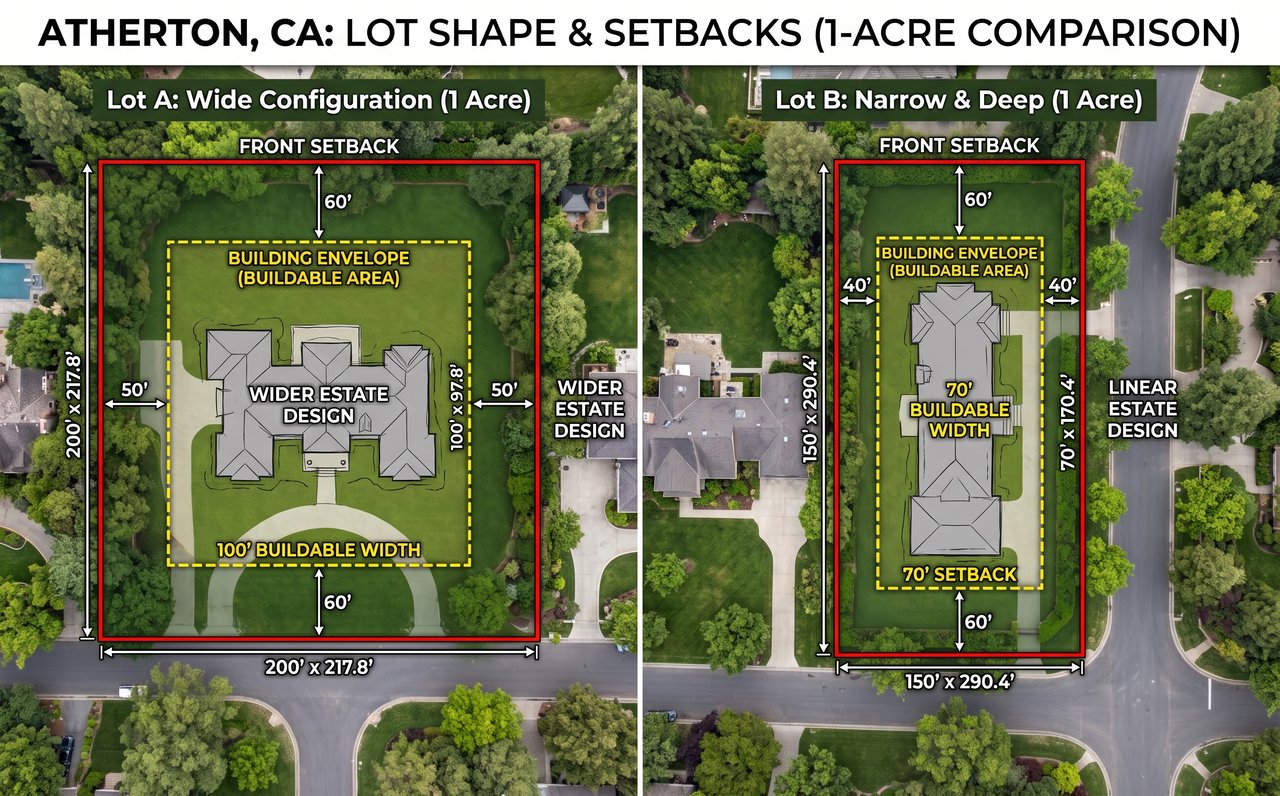
A five-acre parcel with steep terrain, limited access, or significant development restrictions may offer less usable building area than a smaller, relatively level lot.
Important factors affecting land value include:
- Lot size and configuration.
- Buildable area and topography.
- Access roads and driveway conditions.
- Views and surrounding landscape.
- Geologic and soil conditions.
- Utility availability.
- Recorded easements and property restrictions.
- Applicable zoning and development standards.
For buyers interested in remodeling or constructing a custom residence, understanding these factors before purchasing is particularly important.
A visually attractive property may have significant development limitations that are not apparent during a showing.
5. Why Geologic Conditions Matter When Buying a Portola Valley Home
Portola Valley's location within the Santa Cruz Mountains creates important geological considerations for residential property owners.
Some properties may be affected by steep slopes, landslide potential, soil movement, drainage conditions, or proximity to mapped earthquake faults.
The Town of Portola Valley maintains official geologic and ground movement potential maps that help identify areas requiring further investigation.
These maps may be relevant to existing homes as well as properties being considered for renovation or redevelopment.
Before purchasing, buyers should investigate whether the property has experienced:
- Foundation settlement or structural movement.
- Previous landslides or slope instability.
- Drainage or erosion problems.
- Retaining wall failures.
- Unpermitted grading or hillside improvements.
- Other geologic conditions requiring professional evaluation.
Depending on the property, buyers may benefit from consulting a licensed geotechnical engineer or engineering geologist.
The town's Geologic and Ground Movement Potential Maps provide an important starting point for evaluating these issues.
6. Wildfire Risk and Homeowners Insurance Are Essential Considerations
Portola Valley's wooded setting and hillside terrain contribute to its natural beauty, but they also create wildfire-related considerations.
California's evolving wildfire risk environment has made homeowners insurance an increasingly important part of the purchasing process.
Some properties may be located within designated fire hazard severity zones or areas with substantial vegetation and challenging emergency access.
Buyers should investigate a property's wildfire exposure and obtain insurance quotes before removing applicable contractual contingencies.
Important considerations include:
- Applicable fire hazard severity zone designation.
- Availability and cost of homeowners insurance.
- Roofing and exterior construction materials.
- Vegetation management and defensible space requirements.
- Driveway width and emergency vehicle access.
- Water supply and fire protection infrastructure.
- Potential costs of property improvements to reduce wildfire exposure.
Insurance availability and premiums can vary significantly from one property to another.
Buyers should not assume that an insurance policy available for a nearby home will necessarily be offered for the property they intend to purchase.
Early investigation can help avoid unexpected expenses or financing problems during escrow.
7. Septic Systems, Sewer Connections, and Utilities
Another important difference between Portola Valley and more urban Silicon Valley communities involves wastewater systems and utility infrastructure.
Some Portola Valley properties use onsite septic systems, while others are served by public sewer infrastructure.
According to the Town of Portola Valley, West Bay Sanitary District provides wastewater collection services in portions of the community, while San Mateo County Environmental Health oversees matters involving septic systems.
For a property with a septic system, buyers should consider obtaining appropriate inspections and reviewing:
- System location and capacity.
- Age and maintenance history.
- Available permits and records.
- Condition of the tank and disposal field.
- Potential requirements associated with additions or redevelopment.
- Available space for repair or replacement facilities.
A septic system that adequately serves an existing residence may not necessarily accommodate a substantially expanded home or additional residential units.
Other infrastructure considerations may include electrical service capacity, private access roads, drainage systems, and water availability.
These factors can materially affect construction budgets and the feasibility of future improvements.
8. Is It Better to Buy an Existing Home or Build a Custom House?
Portola Valley attracts buyers interested in both existing residences and custom residential construction.
Purchasing a completed home may provide a more predictable path to occupancy and allow buyers to evaluate the existing property's physical condition.
However, older homes sometimes require substantial renovations or infrastructure improvements.
For buyers interested in building a custom residence, an attractive parcel may provide an opportunity to create a home designed around the surrounding landscape.
Nevertheless, custom construction in Portola Valley can involve complex planning, engineering, and permitting considerations.
Buyers should evaluate:
- Permitted building size and height.
- Site coverage and setback requirements.
- Architectural review procedures.
- Tree preservation requirements.
- Geotechnical and drainage engineering.
- Fire protection requirements.
- Utility and wastewater infrastructure.
- Estimated construction and financing expenses.
Before purchasing land or an older residence primarily for redevelopment, buyers should complete an appropriate feasibility review.
The presence of a large lot does not automatically establish the right to construct a correspondingly large residence.
9. How Do Mortgage Rates Affect Portola Valley Buyers?
Mortgage rates are an important consideration for buyers planning to finance a purchase.
According to Freddie Mac, the national average 30-year fixed-rate mortgage was 7.24% as of October 29, 2026.
This is substantially higher than the exceptionally low mortgage rates available during 2020 and 2021.
However, Portola Valley transactions often involve higher loan amounts, substantial down payments, or cash purchases.
Buyers should evaluate financing options based on their individual circumstances rather than assume that national conforming mortgage averages represent the terms available for luxury properties.
Jumbo mortgage rates, reserve requirements, underwriting standards, and loan structures can differ significantly from standard conforming loans.
When comparing properties, buyers should consider total ownership expenses, including mortgage payments, property taxes, homeowners insurance, maintenance, and potential improvements.
Waiting for lower mortgage rates may be appropriate for some buyers, but future rate movements and property prices cannot be predicted with certainty.
10. Can Proposition 19 Help Buyers Move to Portola Valley?
California Proposition 19 may provide valuable property tax benefits for certain homeowners moving to a replacement principal residence.
Eligible homeowners who are at least 55 years old, severely disabled, or affected by qualifying wildfire or natural disaster circumstances may be able to transfer an existing property tax base to a replacement residence within California.
For example, a qualifying homeowner who has owned a residence for many years may have a relatively low assessed property value under Proposition 13.
When purchasing a replacement home in Portola Valley, Proposition 19 may allow that homeowner to transfer the existing taxable value, subject to applicable requirements and adjustments.
However, Proposition 19 does not automatically allow a homeowner to purchase a significantly more expensive residence without any increase in taxable value.
When the replacement property's market value exceeds the applicable statutory comparison threshold, the excess value is generally added to the transferred taxable value.
The program also has important rules regarding timing, eligibility, and the number of permitted transfers.
Buyers should review the California State Board of Equalization's Proposition 19 guidance and consult appropriate tax professionals before making a purchasing decision based on potential tax savings.
11. Will Portola Valley Home Prices Decline?
Predicting future property values in Portola Valley is particularly difficult because the town has a relatively small number of annual home sales.
Individual luxury transactions can substantially influence monthly and quarterly statistics.
For example, a small number of newly constructed estates selling at exceptionally high prices may increase the town's reported median sale price.
Conversely, a period in which more modest or older residences sell may produce a lower median, even if underlying property values have not changed substantially.
Long-term property values are influenced by factors including:
- Housing supply and buyer demand.
- Silicon Valley employment and economic conditions.
- Mortgage rates and financing availability.
- Land characteristics and development restrictions.
- Property condition and construction quality.
- Insurance costs and environmental risks.
- Broader financial market conditions.
For buyers, understanding the value of an individual property is generally more important than attempting to predict the exact direction of the overall market.
12. What Should Buyers Investigate Before Purchasing in Portola Valley?
Because Portola Valley properties can have complex physical and regulatory characteristics, careful due diligence is essential.
Before completing a purchase, buyers should consider the following:
- Review comparable sales: Evaluate recently sold properties with similar locations, lot characteristics, and improvements.
- Verify property boundaries: Review surveys, recorded easements, and access rights.
- Investigate geologic conditions: Examine available geotechnical reports and the town's official hazard maps.
- Assess wildfire exposure: Review applicable hazard classifications and fire protection requirements.
- Obtain insurance quotes: Confirm that appropriate coverage is available on acceptable terms.
- Inspect septic or sewer systems: Determine the property's wastewater arrangement and investigate its condition.
- Review building permits: Verify the status of significant additions, renovations, and accessory structures.
- Evaluate zoning and development potential: Confirm applicable restrictions before relying on future construction plans.
- Inspect the residence: Consider general, roof, structural, drainage, and other specialized inspections as appropriate.
- Calculate total ownership costs: Include financing, taxes, insurance, utilities, maintenance, and anticipated improvements.
These investigations can help buyers make informed decisions and reduce the likelihood of unexpected expenses after closing.
Frequently Asked Questions About Portola Valley Real Estate
Are there homes for sale in Portola Valley in 2026?
Yes. According to MLSListings, Portola Valley had nine active single-family listings in its October 2026 market report. Available inventory changes as properties are listed, sold, or withdrawn from the market.
What is the median home price in Portola Valley?
The October 2026 median single-family sale price was approximately $4.55 million. However, individual properties can sell for substantially more or less depending on lot size, location, condition, and other characteristics.
Why are Portola Valley homes expensive?
Portola Valley's combination of limited housing supply, desirable residential land, privacy, natural surroundings, and proximity to Silicon Valley employment centers contributes to its high property values.
Is Portola Valley a good place to buy a luxury home?
Portola Valley may appeal to luxury buyers seeking privacy, large residential parcels, and access to open space. However, each property should be evaluated for location, condition, environmental risks, financing requirements, and long-term ownership costs.
Are all Portola Valley homes on septic systems?
No. Some properties have onsite septic systems, while others are served by public sewer infrastructure. Buyers should verify the wastewater arrangement for each individual property.
Are hillside properties in Portola Valley more difficult to develop?
They can be. Steep terrain, geologic conditions, drainage, access limitations, and development restrictions may increase the complexity and expense of construction. A property-specific engineering and zoning review is advisable before purchasing for redevelopment.
Should I wait to buy a home in Portola Valley?
The decision depends on your financial readiness, available properties, and long-term plans. Waiting may be appropriate if no suitable property is available or if purchasing would create excessive financial pressure. However, future mortgage rates and home prices are uncertain.
Final Thoughts: Is Portola Valley the Right Place to Buy a Home?
Portola Valley offers a distinctive residential lifestyle that is increasingly difficult to find in the heart of Silicon Valley.
Its natural surroundings, established neighborhoods, spacious properties, and proximity to major employment centers make it appealing to buyers seeking privacy and outdoor recreation.
However, the town's relatively limited housing inventory means that finding the right property can require patience and careful planning.
Buyers should also recognize that Portola Valley properties may involve considerations that are less common in more urban communities, including wildfire exposure, geologic conditions, septic systems, and complex development restrictions.
For buyers who value the town's semi-rural environment and are financially prepared for the responsibilities of ownership, Portola Valley can offer an attractive long-term residential opportunity.
The key is finding a property that combines an appropriate purchase price with desirable location, physical characteristics, and manageable ownership costs.
Explore Portola Valley Homes With Milad Real Estate
At Milad Real Estate, we help buyers and sellers navigate residential real estate transactions throughout Portola Valley, Woodside, Menlo Park, Atherton, Palo Alto, Los Altos, and surrounding Silicon Valley communities.
As both a real estate broker and attorney, Aria Vatankhah brings experience in property transactions, contractual matters, real estate development, and land-use considerations.
Whether you are searching for a luxury estate, considering a hillside property, or evaluating land for future development, Milad Real Estate can help you assess the opportunities and challenges associated with your purchase.
Explore Portola Valley homes for sale or visit Milad Real Estate to learn more.
Aria Vatankhah
Founder, Milad Real Estate
Real Estate Broker | Attorney at Law
Phone: 650-799-8168
Email: [email protected]
Sources: MLSListings — Portola Valley Market Statistics; Town of Portola Valley — Trails and Open Space; Town of Portola Valley — Geologic Maps; Town of Portola Valley — Sewer and Septic Systems; Freddie Mac — Mortgage Rates; California State Board of Equalization — Proposition 19.
Updated November 2026. Housing market statistics reflect the indicated reporting period and may change. Property conditions, development potential, insurance availability, and financing requirements vary by property. This article provides general real estate information and does not constitute individualized legal, tax, lending, or financial advice.